

For the hydrogen economy to further gain momentum, there is a requirement to reduce costs related to green hydrogen production. While much of the industry’s focus has been on improving electrolyser scale and lowering capital costs, Jolt Solutions is attacking the problem from a different angle: by increasing the electrical efficiency of the stack via better electrodes. And the results are capturing interest across the industry.
“Activated Electrodes are one of the most critical components for performance and energy efficiency,” says Wayne Thornhill, Chief Sales Officer at Jolt Solutions. Based in Barcelona, Jolt is making a name for itself by developing high-performance electrode coatings that enhance efficiency, durability, and scalability in alkaline water electrolysis (AWE) and anion exchange membrane (AEM) technologies.
The Backbone of AWE Efficiency
Alkaline water electrolysis remains the dominant technology for green hydrogen production, representing around 80% of the market. Its appeal lies in its relatively low cost, durability, and ability to scale for large projects. However, this technology still hinges on legacy electrode materials, typically nickel or nickel with a high-surface-area coating like Nickel Raney.
Historically, these standard electrodes have introduced limitations. “Conventional electrodes suffer from degradation during voltage cycles and don’t perform well during shutdowns,” Thornhill explains. “That’s a big problem when you’re integrating electrolysers with intermittent renewable energy like solar and wind.”
Nickel Raney, often used for its enhanced surface area and catalytic performance, does offer better hydrogen generation rates. But it’s not without flaws: early degradation, sensitivity to impurities, and poor performance under dynamic load conditions all impact its long-term efficiency.
To address these challenges, Jolt has created a new class of high-efficiency electrodes, applying unique coating processes tailored for today’s hydrogen industry.
Introducing Sparkfuze: High Surface Area Meets High Durability
At the heart of Jolt’s innovation is the Sparkfuze coating process, a technology capable of applying catalysts to a wide range of nickel materials, including complex nickel substrates like foam and felt, as well as more traditional materials like expanded meshes and woven meshes. This results in electrodes with dramatically higher surface areas, which translates directly into better performance and lower energy consumption.
“By creating nanocrystalline catalyst layers, we greatly improve the surface area of traditional electrodes, which improves performance and by selecting the right catalysts, it is further boosted. When combined with higher-surface-area substrates as well (something traditional coating techniques can’t manage) it’s a compounded improvement,” Thornhill says. “More surface area means more reaction sites. More catalyst means faster kinetics. The result is less electricity needed per kilogram of hydrogen.”
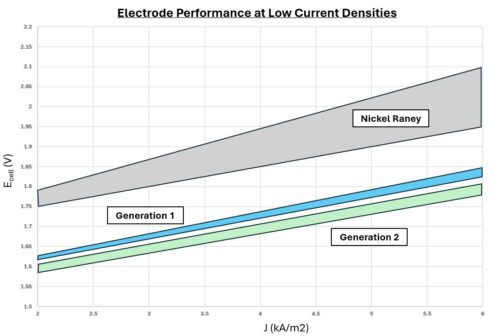
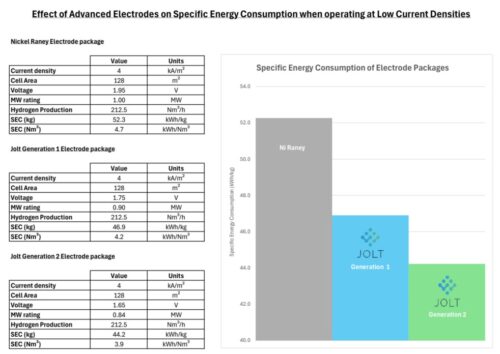
Indeed, testing has shown that switching from traditional electrodes to Jolt’s advanced versions leads to a noticeable reduction in specific energy consumption, both in kWh/kg and kWh/Nm³, (Balance of Stack).
In an industry where operational costs are driven primarily by electricity consumption, these improvements have significant implications for the levelized cost of hydrogen (LCOH). In other words, even if the upfront CAPEX is slightly higher, the long-term energy savings and increased durability can result in a far more competitive project over time.
Designed for Scale, Built for Speed
It’s one thing to engineer a high-performance electrode in a lab; it’s another to do it at scale. That’s where many startups and academic spinouts stumble. Not so with Jolt.
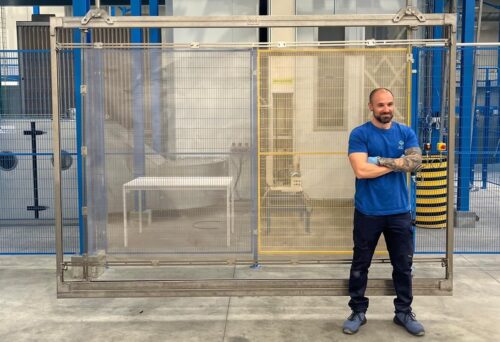
“Our process is inherently scalable,” says Thornhill. “We can coat large electrode areas, up to 4.9 square meters, and we’re already producing at industrial volumes.”
Jolt’s Barcelona-based facility is built to supply multi-gigawatt projects, and the company’s modular production model means it can rapidly expand to meet local demand in global markets. By deploying smaller coating lines near electrolyser installations, Jolt is also looking to reduce downtime during maintenance and shorten supply chains.
“Fast, local manufacturing of electrodes will be critical as green hydrogen scales globally,” Thornhill adds. “If we can enable shorter service intervals and faster turnaround, electrolyser uptime goes up, and the economics improve for everyone.”
Future-Proofing the Hydrogen Economy
While Jolt’s initial focus is on AWE and AEM electrolysis, its ambitions extend beyond hydrogen. The company is already rolling out electrodes for other electrochemical applications, including saltwater chlorination, chlor-alkali processes, and water treatment.
This diversification reflects the growing interest in clean industrial technologies across sectors. But make no mistake: hydrogen remains the primary focus.
“There’s a lot of excitement in the hydrogen space, but there’s also a lot of hype,” Thornhill cautions. “We’re trying to cut through that by delivering real, measurable improvements to efficiency, reliability, and scalability. That’s what the market needs now.”
A Silent Revolution with Massive Impact
Electrodes might not grab headlines like electrolyser gigafactories or hydrogen-powered aircraft. Yet, their role in shaping the economics of hydrogen is immense.
By focusing on this critical, often overlooked component, Jolt Solutions is empowering hydrogen producers to get more out of every kilowatt of renewable electricity, and ultimately, to bring clean hydrogen into cost parity with fossil alternatives.
“We’re not reinventing the wheel,” Thornhill says with a grin. “We’re just making it spin a lot more efficiently.”
As the green hydrogen industry pushes toward gigawatt-scale deployments and tighter margins, innovations like Sparkfuze may prove decisive, not only for reducing the LCOH but for making the hydrogen economy truly sustainable.

