Innovation alone will not deliver the hydrogen economy. As projects move from pilot plants to industrial-scale deployment, developers are increasingly looking beyond electrolyser performance. Reliability, integration, bankability and the ability to replicate successful projects are becoming just as important as efficiency or capital cost.
That was one of the key messages from Hydrogen Standard’s conversation with Rafael Pauli, VP of Sales of Stargate Hydrogen, and Simo Säynevirta, Head of ABB’s H2 Springboard Ecosystem Program, during the World Hydrogen Summit in Rotterdam.
The interview highlighted how the relationship between technology innovators and established industrial companies is evolving, and why collaboration could become one of the defining factors in accelerating the commercial deployment of green hydrogen.
Bridging innovation and industrial scale
Hydrogen has no shortage of innovation. Across Europe, North America and Asia, new electrolyser technologies continue to emerge, each promising improvements in efficiency, durability or cost. Yet many promising technologies struggle to progress beyond demonstration projects.
For ABB, the challenge is not simply identifying innovative technologies but helping those technologies reach commercial maturity.
“Even the best innovation, if it’s left in a vacuum, cannot actually deliver that benefit,” explains Säynevirta.
Through its H2 Springboard Ecosystem Program, ABB works with emerging hydrogen technology companies to combine innovative products with industrial-grade electrification, automation and systems integration.
Rather than competing with electrolyser manufacturers, ABB positions itself as an enabler, bringing decades of experience delivering complex industrial infrastructure to technologies that are ready to scale.
For Stargate Hydrogen, that industrial expertise complements its own focus on electrolyser development.
“We develop the electrolyser technology, while ABB brings the industrial expertise in electrification and automation,” says Pauli. “Together we can provide customers with a much more complete solution.”
The collaboration reflects a broader trend across the hydrogen industry. As projects become larger and more capital intensive, developers increasingly prefer integrated solutions backed by experienced industrial partners rather than assembling multiple technology providers independently.
Moving beyond bespoke hydrogen projects
One of the strongest themes throughout the discussion was the industry’s need to move away from bespoke engineering.
Many hydrogen facilities today are effectively custom-designed. While that approach has supported early innovation, it also increases engineering effort, project complexity and delivery times.
ABB believes the next phase of market development requires greater standardisation.
“We need to move from one-off projects towards repeatable blueprints,” Säynevirta explains. “That’s how industries scale.”
Creating standardised building blocks allows engineering work to be replicated across projects rather than reinvented each time. It reduces technical risk for developers, simplifies procurement and shortens delivery schedules, factors that become increasingly important as projects grow from tens to hundreds of megawatts.
It is also an area where ABB’s experience in industrial automation, electrification and process industries provides significant value.
Engineering designed for deployment
Stargate Hydrogen’s latest product, the Aurora alkaline electrolyser platform, has been designed with this philosophy in mind.
Rather than focusing solely on improving the electrolyser system performance, the company has sought to simplify deployment, operation and long-term maintenance.
“We designed this module for easy integration, reduced engineering efforts and de-risking your project,” says Pauli.
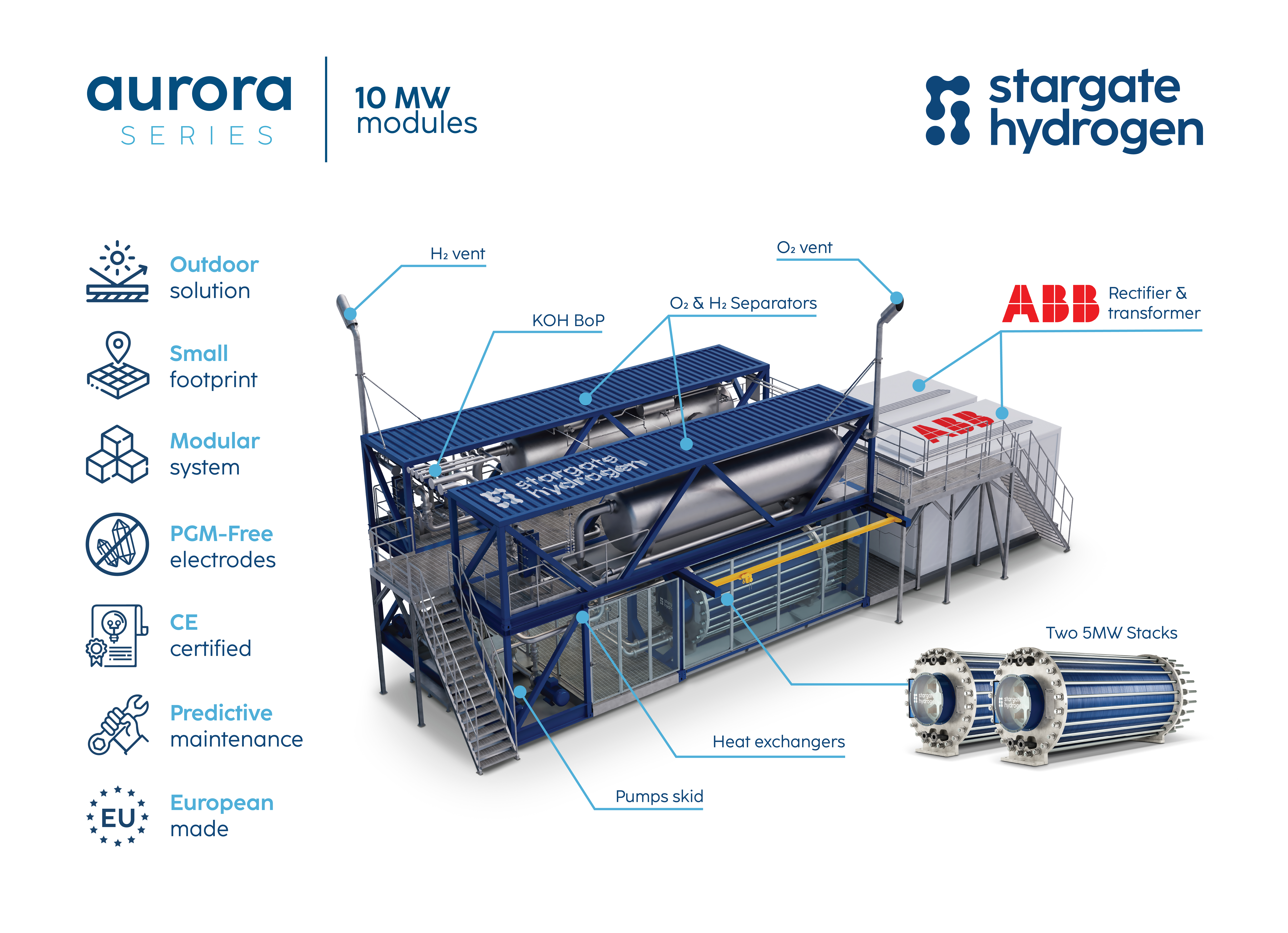
The 10 MW modular system combines a compact two-storey skid layout with integrated balance-of-plant components, allowing developers to reduce installation complexity while maintaining flexibility for larger projects.
Serviceability was another major design consideration.
Unlike many conventional systems that require significant dismantling during maintenance, Aurora has been engineered so that critical servicing can be carried out directly on site.
For industrial operators, reducing downtime can have a significant impact on the lifetime economics of hydrogen production.
 Built for industrial conditions
Hydrogen production is increasingly moving beyond carefully controlled demonstration sites into demanding industrial environments.
Recognising this, Stargate Hydrogen has designed Aurora for outdoor operation, including temperatures as low as -35°C.
That capability opens opportunities across Northern Europe, Canada and other cold-climate regions without requiring extensive climate-controlled infrastructure.
Combined with its modular design, the Aurora System has only a 17.8m²/MW footprint, ideal for industrial plants where every square meter counts. The modularity also allows EPCs to reduce both civil engineering requirements and overall project complexity.
While electrolyser efficiency remains important, practical deployment considerations such as installation, accessibility and operational reliability are becoming increasingly influential purchasing criteria.
Integration is becoming a competitive advantage
As hydrogen projects expand, electrolysers are only one component within a much larger industrial system.
Renewable power, transformers, rectifiers, electrical distribution, automation, safety systems and plant controls must all operate together seamlessly.
This growing complexity is one reason why partnerships such as that between Stargate Hydrogen and ABB are attracting attention.
ABB contributes far more than electrical equipment. Its expertise in power conversion, automation and digital control enables electrolyser systems to be integrated into complete industrial facilities.
For project developers, this reduces interface risks between suppliers while improving confidence among investors, EPC contractors and lenders.
The partnership therefore addresses one of the industry’s emerging priorities: delivering bankable hydrogen projects rather than simply innovative technology.
Accelerating commercial adoption
The collaboration also demonstrates how the hydrogen supply chain is maturing.
Instead of individual companies attempting to provide every component themselves, specialists are increasingly working together to deliver integrated solutions.
For Stargate Hydrogen, partnering with ABB provides access to global industrial expertise and customer confidence.
For ABB, working alongside innovative electrolyser manufacturers enables the company to accelerate commercial deployment of new hydrogen technologies while remaining technology agnostic.
Both companies see this collaborative approach as essential if green hydrogen is to move beyond today’s relatively limited deployment volumes.
Looking ahead
The hydrogen sector continues to face familiar challenges, including project financing, permitting delays and uncertain demand. Yet conversations at the World Hydrogen Summit suggested that the industry’s priorities are gradually shifting.
Rather than asking only which electrolyser technology performs best, developers are increasingly asking which solutions can be delivered reliably, integrated efficiently and replicated across multiple projects.
That evolution places greater emphasis on industrial partnerships.
As Säynevirta notes, innovation creates opportunity, but collaboration is what transforms innovation into commercially deployable infrastructure.
For Stargate Hydrogen, Aurora follows a design philosophy centred on reducing engineering effort, simplifying maintenance and making hydrogen projects easier to build.
Combined with ABB’s industrial integration expertise, the partnership offers an example of how technology developers and established engineering companies can work together to address one of the hydrogen industry’s biggest challenges: turning promising innovation into scalable, repeatable and commercially viable hydrogen production.
As the sector moves towards larger and more complex projects, such collaborations are likely to become increasingly important, not only for the companies involved, but for the continued development of the hydrogen economy itself.